
Daniel’s four-beast vision in Belshazzar’s first year (Dan. 7. - 553BC)
Jeremy Gibson
In 556 BC, after Labashi-Marduk was assassinated, Nabonidus became king of Babylon1. Three years later, after suppressing an uprising in Ammananu, Nabonidus for no apparent reason, exiled himself to Teima (modern-day Tayma)2. During his absence, his ambitious son Belshazzar ruled Babylon1. In the first year of Belshazzar’s reign (553), now into his sixties, Daniel received a nocturnal, panoramic vision of the entire future of planet earth, minus the church era. The Apostle Paul was granted the final piece of the jigsaw, the mystery of the church (Eph 3:1-7). In this way, Paul filled up, or brought to completion, the revelation of God in the Word (Col. 1:25).
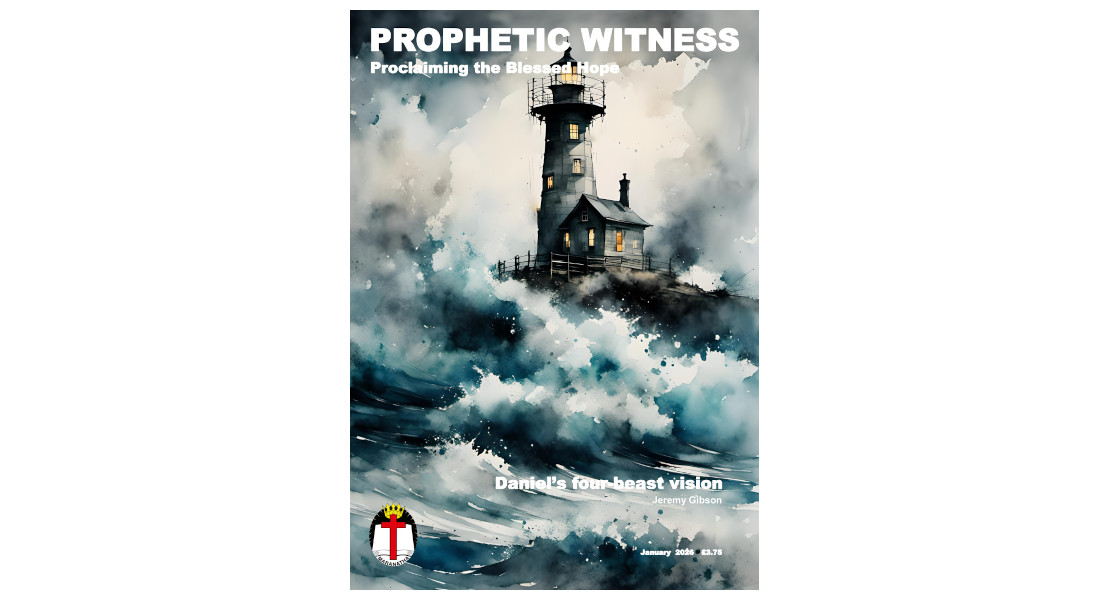
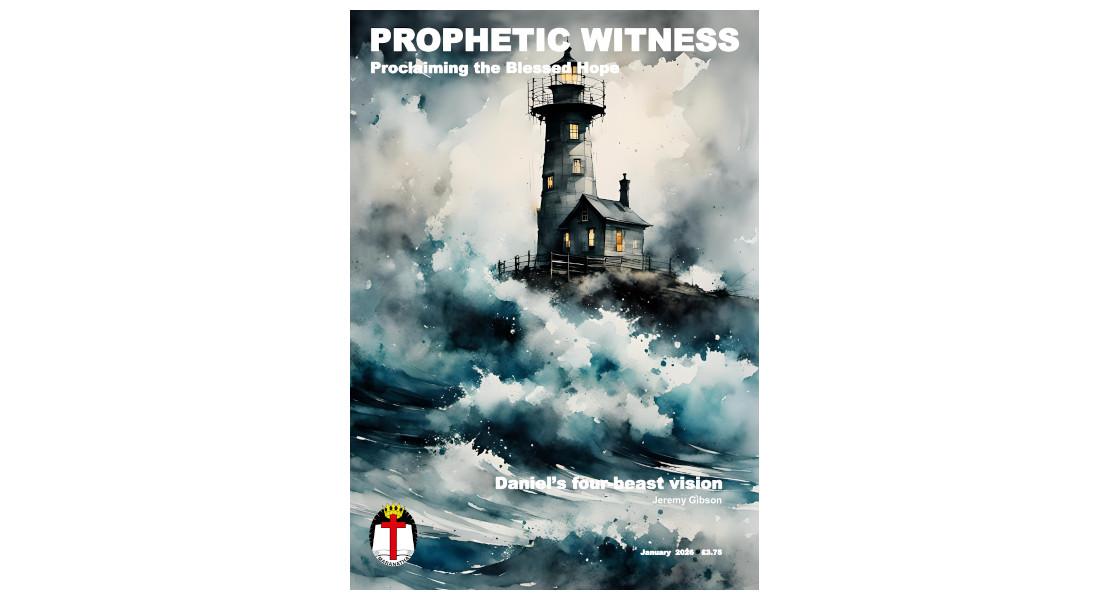
In his dream, Daniel saw four terrifying beasts rise out of a stormy sea (Dan. 7:1-3). The sea probably signified a deeply troubled Gentile world. Each grotesque animal represented one king (or kingdom) that would ‘arise out of the earth’ (vv16-17), and correlated precisely with the four divisions of Nebuchadnezzar’s image in chapter 2. Nebuchadnezzar had seen these empires as stunning and glorious (how men would view them). Daniel saw them as violent, dangerous, and deformed (God’s evaluation of them).
The first beast, representing Babylon, had the appearance of a lion (depicting strength) with eagle’s wings (suggesting speed - v4). The plucking off of its wings, its being made to stand upright, and its being given a man’s heart, looked back to Nebuchadnezzar’s conversion (v4; cf. Dan. 4). The second beast, standing for the combined Medo-Persian Empire, was a powerful, lopsided bear with three ribs in its mouth that was commanded to eat more flesh (v5). Although for many years the Medes of the northern Iranian plateau had controlled their southern Persian cousins, Cyrus’ soon-to-take-place victory at Pasargadae (550BC) would swing the balance of power. Thereafter, the Persians would dominate. 2, 3 This Persian ascendancy was represented by the bear’s asymmetry.
Two years later (in 551BC), in another vision, Daniel saw this imminent Persian pre-eminence as one of a ram’s two horns being elevated above the other (Dan. 8:3). The third beast, picturing Greece, was a leopard (signaling ferocity) with four wings on its back (testifying to the rapidity of its movement), and four heads (standing for the four divisions of the Greek Empire after Alexander the Great’s death - v6). So far, straightforward. Not the writings of a second century forger, recounting human history as it had happened (as critics purport), but the inspired writings of a sixth century BC prophet, predicting accurately, future Gentile empires.
The fourth beast, and the empire it represented, was different from the others, more vicious, aggressive, and complicated, and the one which concerned Daniel the most (vv7-8 & 19-26). While the preceding three could be likened to known animals, this one was beyond such comparison. Its terrifying propensity to destroy was conveyed by great iron teeth, brazen claws, and ten deadly horns (vv7 & 19-20). It was the Roman Empire, which Daniel saw extending all the way to Messiah’s glorious coming to establish His never-ending kingdom. When Daniel had his vision, all (apart from Nebuchadnezzar’s humbling) was still future, both near and distant. From our viewpoint, there is a past and future aspect to the fourth empire. Historically, the Roman Empire replaced the Greek empire, ruling with the iron strength of battle-hardened legions. Gradually, over the centuries, that empire declined and fell. However, in the future, it will be revived and ruled by ten kings, represented by ten horns. Three of these kings will be deposed by an eleventh king, portrayed as a distinct little horn that will grow in power, having bright eyes (speaking of immense intelligence) and a boastful mouth (implying unbridled, blasphemous arrogance) (vv8; 11; 20 & 24-25). He is the Antichrist, who for three-and-one-half years will persecute severely the Jewish people and prevent them from keeping their divinely-ordained feasts (vv21 & 25; cf. 9:27).
In his vision, Daniel was transported to heaven, where he saw thrones set up, and the white-haired, Ancient of days (implying eternal existence, infinite wisdom, and matchless dignity), sitting on His unchanging, everlasting throne (v9). His clothing ‘was white as snow’ (symbolizing purity). His throne, His wheels, and the stream that flowed from Him, were aflame (conveying the all-consuming power and holiness of deity) (vv9-10; cf. Ex. 3:2; 19:18; Ezek. 1:15; Heb. 12:29). Myriad angels served Him (v10; cf. Deut. 33:2; Psalm 68:17). It was judgment time when the books will be opened (v10). Daniel’s awe-inspiring heavenly sight, corresponds with the vision the Apostle John had more than 600 years later on the Isle of Patmos. John observed God enthroned in majesty and surrounded by twenty-four inferior thrones, seven burning lamps of fire, and a multitude of adoring angels (Rev. 4:1-11 & 5:9-14). With the earth ripe for judgment, John witnessed the Lamb unleash the wrath of God by opening the seals of the book (Rev. 5:1-8 & 6:1 cf.).
Having just seen the incomparable glory of God, Daniel wanted to know what would become of the boastful little horn (v11). As he watched, the fourth beast was slain and burned (v11). Even though the first three kingdoms were to fall, their influence would extend beyond their time in power (v12). History has proven this to be the case. Take for example the Greek empire. More than two millennia after its downfall, it continues to shape the way we think, its language supplying much of the terminology: ‘of medicine and the life of science, the elements and processes of chemistry, most of the technical terms of astronomy, of geography, and philosophy. Indeed, many of the words which lie at the heart of the greatest achievements and the most deep-seated problems of our times are derived from Greek’2. At Christ’s second coming, the fourth empire and its leader, the Antichrist, will be totally destroyed, never to rise again. The Apostle John also foresaw this, with the beast (the Antichrist) and his false prophet being cast into the Lake of Fire (Rev. 19:20).
When Israel’s High Priest interrogated the Lord Jesus Christ, he became so frustrated by His dignified silence, that he forced Him to speak by putting Him under oath (Matt. 26:62-63; cf. Lev. 5:1). The Lord replied: “thereafter shall ye see the Son of Man sitting on the right hand of God, and coming in the clouds of heaven” (Matt. 26:64). He was applying Daniel chapter 7, unequivocally, to Himself. He is the Messianic Son of Man who will come with the clouds of heaven to the Ancient of days to receive “.. dominion, and glory, and a kingdom, that all people, nations, and languages, should serve Him.” (Dan. 7:13-14). For 1,000 years, Christ will reign with His people over the entire world (Dan. 7:27; Matt. 5:5; Rev. 20:1-6). Thereafter, the millennium will give way to the eternal state, when God and Christ will have ‘everlasting dominion’ (Dan. 7:14; 1 Cor. 15:24-28 & Rev. 21:1 cf.). In contrast to the four earthly kingdoms that were to be broken, God’s unshakeable kingdom will never end (Dan. 7:14 & Heb. 12:28).
This amazing revelation overwhelmed and perplexed Daniel (Dan. 7:15-16). Failing to grasp its meaning, he did what we should all do if we do not understand something. He asked for an explanation, in his case, from one of the attendant angels (v16). Even though its mind-blowing interpretation troubled Daniel deeply, like Mary in the NT (Luke 2:19 & 51), he treasured its truth in his heart (v28).
1 Beaulieu P-A, The Reign of Nabonidus King of Babylon 556-539 B.C. (New Haven and London: Yale University Press, 1989), p. 87.
2 Ibid, pp. 168, 169.
3 Ibid, p. 185.
4 Kriwaczek P. BABYLON MESOPOTAMIA AND THE BIRTH OF CIVILIZATION (London: Atlantic Books, 2010), p. 272.
5 Llewellyn-Jones Lloyd, PERSIANS The Age of the Great Kings (London: Wildfire, 2022), pp. 59, 60.
6 Taplin O, GREEK FIRE (London: Jonathan Cape Ltd., 1989), p. 7.
Also in this issue
03 From the PWMI President - Alec Passmore
04 Food for Thought - Dr Charles Sommerville
05 General Director’s Report 2025 - Colin Le Noury
06 Daniel’s Four Beast Vision in Belshazzar’s First Year (Dan. 7) - Jeremy Gibson
08 Signs of The Times - Tony Pearce
12 Thoughts on Chapter 5 of The Book of Revelation - David Notman
14 Spotlight on Israel - Tony Pearce
16 Is The Lord’s Prayer Prophetic? - Philip Jones
17 El, Elohim - Dr Charles Sommerville
18 Christ’s ‘Church’ and Christ’s ‘churches’ Part 1 - Richard Salmon
21 Awake and Watching - Jonathan Brentner
22 Church Listings
23 What’s On?
24 Tract of the Month - JFKs Question and Yours.pdf